Thursday, 26 November 2009

Futurism

Futurism was an international, artistic and social movement, which started in Italy with the appear of the Futurism Manifesto published on 20 February 1909 by Filippo Tommaso Marinetti, who is considered to be the founder of Futurism. By the word Futurism, which refers to the future, Marinetti tried to emphasize innovation, development, social revolution but also discard all the things that had been created in the past - "We will destroy the museums, libraries, academies of every kind..."

Futurist ideology was associated with speed, dynamism, technology, noise, power, machines and violence. Artists, who were inspired by Marinetti's manifesto, very often tried to express movements, dynamism and speed in the visual arts.


The painting above is a good example of what Futurists tried to achieve. It was painted in 1912 by Gicomo Balla and is called Dynamism of a Dog on a Leash. The artist tried to capture the movement of a dog by layering multiple images. In my opinion it gives you the feeling of a motion. Today's digital artists do quite similar thing by applying motion blur to some parts of an image. In the example below, by Andree Wallin, you can see how the artist blurred the background to show the speed of the spaceship.

Other artists, influenced by Cubist style of painting, attempted to simulate dynamism by fragmented surface of the paintings. One of the most famous artists that used that kind of technique was Umberto Baccioni. He was an Italian painter and sculptor. My favourite painting of his, is probably Elasticity painted in 1912 (below).


The painting shows a man riding a horse. What I like about this painting is how the artist visualised the horse - to me it looks very dynamic and almost machine-like. I also like the colours that he used, in my personal opinion, they look quite aggressive and vivid.

As a sculptor, Baccioni created many fantastic sculptures, which reflected the Futurist idea. In his scuptures, the same as in his painting, Baccioni tried to create the feeling of a motion. You can also notice the relationship between his scultures and paintings, which show quite similar Cubist style.

Architects were also involved in the Futurism. The most fomous among them was Antonio Sant'Elia, which was in extremaly influential. As many Futurists, Sant'Elia was a nationalist and joined the army. Unfortunately, he was killed in WWI, 1915. However, he left many of his futurist drawings, which inspired many architects in later years. I really like his work, even today it looks quite modern and futuristic. The buildings remind of some kind of factories, which I think represent the development, machines and speed - everything that Futurism was all about.

Contemporary artists from Atkinson+Co visualised Sant'Elia's ideas by creating 3D scenes based on his sketches and projects.

I think Futurism was very interesting movement full of amazing art and artists that I really appreciate. However, I do not agree with the Futurist view on politics.

Thursday, 12 November 2009

Surrealism

Surrealism was a cultural movement that involved many aspects of life such as art, cinema and literature that developed mainly from Dada. It started with the release of the 'Surrealist Manifesto' by poet and surrealist theorist Andre Breton in 1924. As he described, "Surrealism was a means of reuniting conscious and unconscious realms of experience so completely that the world of dream and fantasy would be joined to the everyday rational world in an absolute reality, a surreality." Surrealists used visuals to express processes happening in the subconscious mind, often taking inspiration from their dreams. It was flourishing in Europe, mainly in Paris (however, it quickly spread around the world attracting many artists, musicians and directors) between WW I and WW II.

One of the most famous and appreciated surrealist artists was Salvador Dali, who was born in 1904, Figeures, Spain. He is most famous for his paintings, however, he was also involved in a film making, sculpture and photography. As a very creative and original artist he always attracted attention of the public and art critiques.

To bring his ideas form subconscious mind, Dali, used to induce hallocinatory states in himself. It was quite efficient method for him as he developed the style very quickly and produced many paintings that made him well-known around the world.

Perhaps, one of his most famous paintings is Persistance of Time (1931). The painting shows melting pocket clocks. 'The general interpretation of the work is that the soft watches are a rejection of the assumption that time is rigid or deterministic. This idea is supported by other images in the work, such as the wide expanding landscape, and the other limp watches, shown being devoured by insects.'


I like this painting as it is quite extraordinary and really dream-like. Also it is very detailed and nice painted what give more realism to the scene.

The Temptaion of Saint Anthony (1946) is another well-known painting of Salvador Dali. The painting represents the temptaion that Saint Anthony had to face during his stay in the Egyptian desrt.


I really like this piece. It is extremely imaginative and surreal. It is also very influencial piece even today. The band Linin Park used the idea of the elephants in one of their music videos: 'Somewhere I belong'

In later years Dali concentrated on academic paintings ispired by Reneisance artist Raphael, creating religious paintings. Salvador Dali died in January 23, 1989 and today is considered to be the greatest of surrelist artists.

Famous Surrealist paintings by other artists:

Rene Magritte - The Son of Man 1964 (left) and The Human Condition 1935 (right)


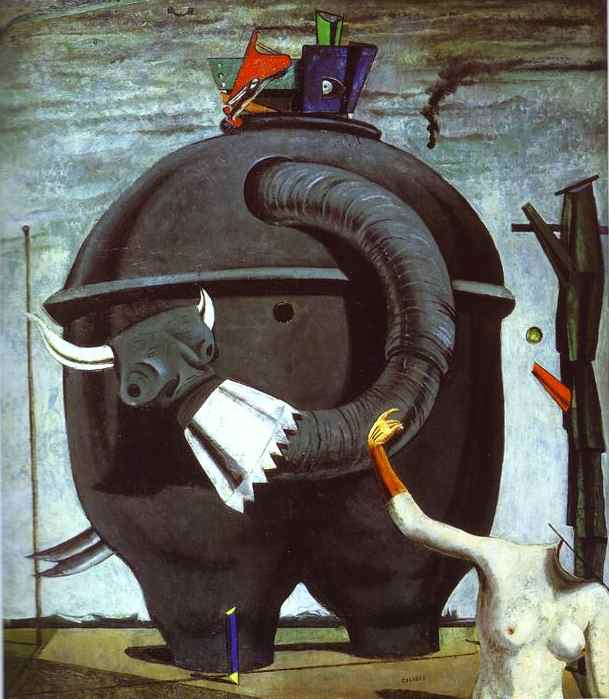
Max Ernst - The Elephant Celebes 1921


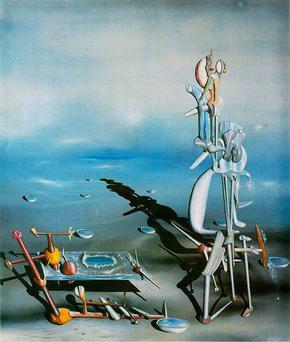
Yves Tanguy - Indefinite Divisibility 1942


(selected quotes from: http://en.wikipedia.org/wiki/ and http://www.ibiblio.org/wm/paint/glo/surrealism/)

Thursday, 5 November 2009

Abstract art

"Art should be purely about the creation of beautiful effects."
Paul Gauguin

Paul Gauguin's thought perfectly describes what abstract art is all about. It uses form and colour to represent something different than the material world. The idea of abstract art was first seen in ancients Greece. The philosopher Plato, thought that 'the highest form of beauty lies not in the forms of the real world but in geometry'. The abstract artists reject all the rules, such as perspective, and often use geometrical, flat shapes to create representation of 'order, purity, simplicity and spirituality'.

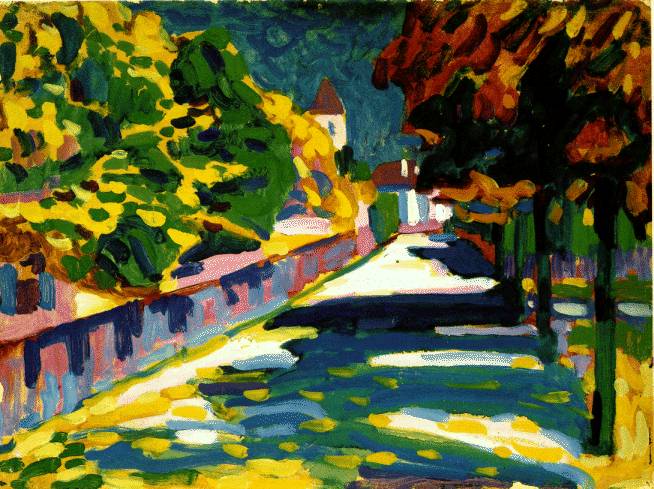
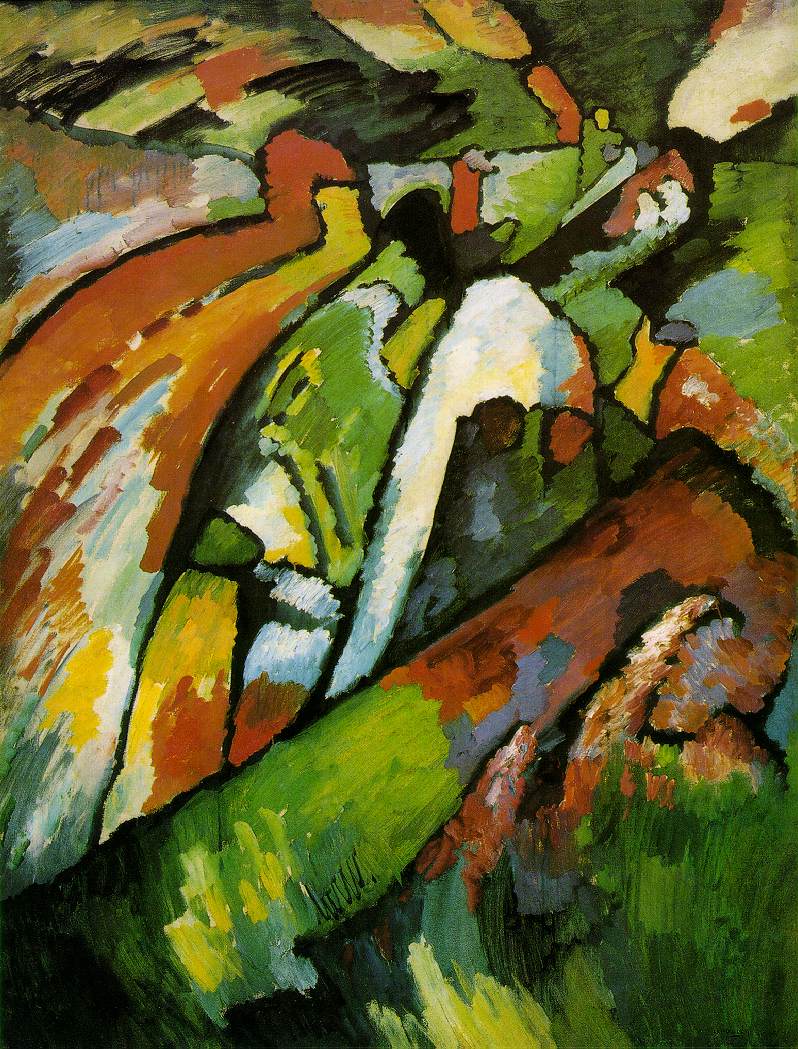
One of the abstract art pioneers was Wassily Kandinsky, born in 1866. He was a Russian painter whose works were one of the very first modern abstract pieces. However, before he started creating abstract works he was developing different styles. Many of his early works, in my opinion, were inspired by Impressionism and Post-Impressionism (left: 'Autumn in Bravia' 1908). His first abstract pieces started to appear around 1910. The painting Improvisation 7 (below, left), although it is kept in the similar style as his previous works, has become rather abstract.


During following years Kandinsky was developing his style and joined the Bauhaus movement as teacher at Bauhaus School in Weimar, founded in 1919 by Walter Gropius. During that period he went completely abstract creating one of his most famous pieces - 'On white II' (above, right) painted in 1923. Personally, I am not a huge fan of abstract art, however in some way I quite like Kandinsky's works. I like the way he used simple shapes to create quite interesting compositions. Also the colours that he had chosen for his paintings work perfectly.

Important part of abstract art was a movement that developed in Netherlands, 1917 - De Stijl. It involved furniture design, architecture and painting and what's more it was all about abstract art.

Theo van Doesburg - a painter and founder of De Stijl along with Piet Mondriaan were the most important figures in the movement. Their styles were quite similar and were represented by different coloured squares and lines. However the difference between them (which appeared in later years) is the layout - Mondriaan would only paint them straight, vertical and horizontal when van Doesburg's paintings were often rotated 45 degrees.


Their work influenced the look of the whole movement and are still influential today. Fashion designers often use Mondriaan's paintings for the patterns. Also the influence can be seen in the architecture.

(selected quotes from: www.tate.org.uk/)

Thursday, 22 October 2009

Art Deco

The second quarter of twentieth century brought radical change to art and design called Art Deco. It was undoubtedly one of the liveliest, magnificent and the most comprehensive movements in the art history. It began in Europe, particularly in Paris, in early years of the twentieth century. Art Deco was really elegant and affected all aspects of live, design and art, starting with fine art and decorative art to fashion; architecture, cars, handbags, glass, bathroom fittings, jewellery, lighting, furniture, transport, product design and even film.

The term ‘Art Deco’ was coined in 1966 and refers to exhibition entitled 'Exposition Internationale des Arts Décoratifs et Industriels Modernes', held at the Musée des Arts Décoratifs in Paris. Originally planned for 1914 but launched in 1925 due to World War I. Many international exhibitions helped promote Art Deco, but none was more important than the exhibition held in Paris. The exhibition brought together many designers from all over the Europe including British, Austrian, Netherlanders, Hungarian, Italian, Spain, Polish, Czechoslovakian, Denmark, Swedish and the USSR designers. Other parts of the world were less well represented – Germany as a main aggressor in World War I was not invited to exhibit. The USA declined to participate. However, in later years ( around 1940s) Art Deco flourished in America.

The style that represented Art Deco was full of streamlined and sleek forms, geometric and angular patterns. It was also characterized by experimenting with industrial materials such as aluminium, stainless steel, glass, shark skin, zebra skin and plastic. This movement was a mixture of many different movements and styles including Cubism, Modernism, Neoclassical, Futurism, Bauhaus and Art Nouveau. Art Deco began a modernist reaction against Art Nouveau and totally took its place after World War I. It was caused by young reformers who believed that beauty does not depend on ornament but can be achieved by sensible use of colour and texture as well as manipulation of form.

Art Deco, like its precursor Art Nouveau, was influenced by many sources from all over the world. Art Deco had many strong European, Asian, African and Meso-American influences. Egypt played a big part in the style of Art Deco. The discovery of Pharaoh Tutankhamen’s tomb, by Howard Carter in November 1922, resulted in huge interest of Egyptian art and culture. Many goods extracted from the tomb such as furniture, cases, mummy, chariot, gold jewellery and unusual golden funeral mask of Pharaoh inspired many designers.

Art Deco survived until 1939, the beginning of the World War II. However, in colonial countries like India or Philippines it became popular in 1960s as a gateway for Modernism. In my personal opinion Art Deco was one of the most admirable movements. What I like about it, is a fantastic use of form. Streamlined, elegant and modern shapes, extraordinary materials, triangle patterns.

Thursday, 15 October 2009

Art Nouveau

Art Nouveau was completely new and decorative style in art and design. It started at the end of 19th and the beginning of 20th centuries and involved wide range of designs, such as furniture, lamps, jewellery, textiles, architecture, illustrations, poster design and painting. It developed mainly in Europe and had many different names - in England and France 'Modern Art', in Germany 'Jugendstil', in Italy 'Stile Liberty'. In some way, Art Nouveau was a reaction against the Industrial Revolution as most of the artists were not in fond of the machine-made goods. Art Nouveau was characterized by complex, swirly leaves, flowers or roots and curved forms, vines and lines.

One of the most recognizable Art Nouveau artists who had a great impact on its look was Alphonse Mucha. He was a Czech painter and designer and was most famous for his fantastic posters. One of his first, which appeared in 1895, gained huge popularity. It was a poster for a play called Gismonda. From the moment that people saw the poster they absolutely loved it and soon they called it Art Nouveau. In the following years Mucha was developing his style and created many beautiful posters, which now are iconic for Art Nouveau style. In my personal opinion the poster are just amazing and really like them. One of the things I am impressed by are the stunning ornaments around the characters. Also I really like how the artist created the characters - combining outlines with very nice shading, which gives quite amazing look.


Another amazing example of Art Nouveau that I was able to find is this doorway in Paris. What I like about are great curvy lines and fantastic ornament around it.


Personally, I think that Art Nouveau is very impressive. However, in my opinion, too much of it can look just too busy and you can be overwhelmed with amount of details in each piece.

Wednesday, 14 October 2009

African influence on modern art

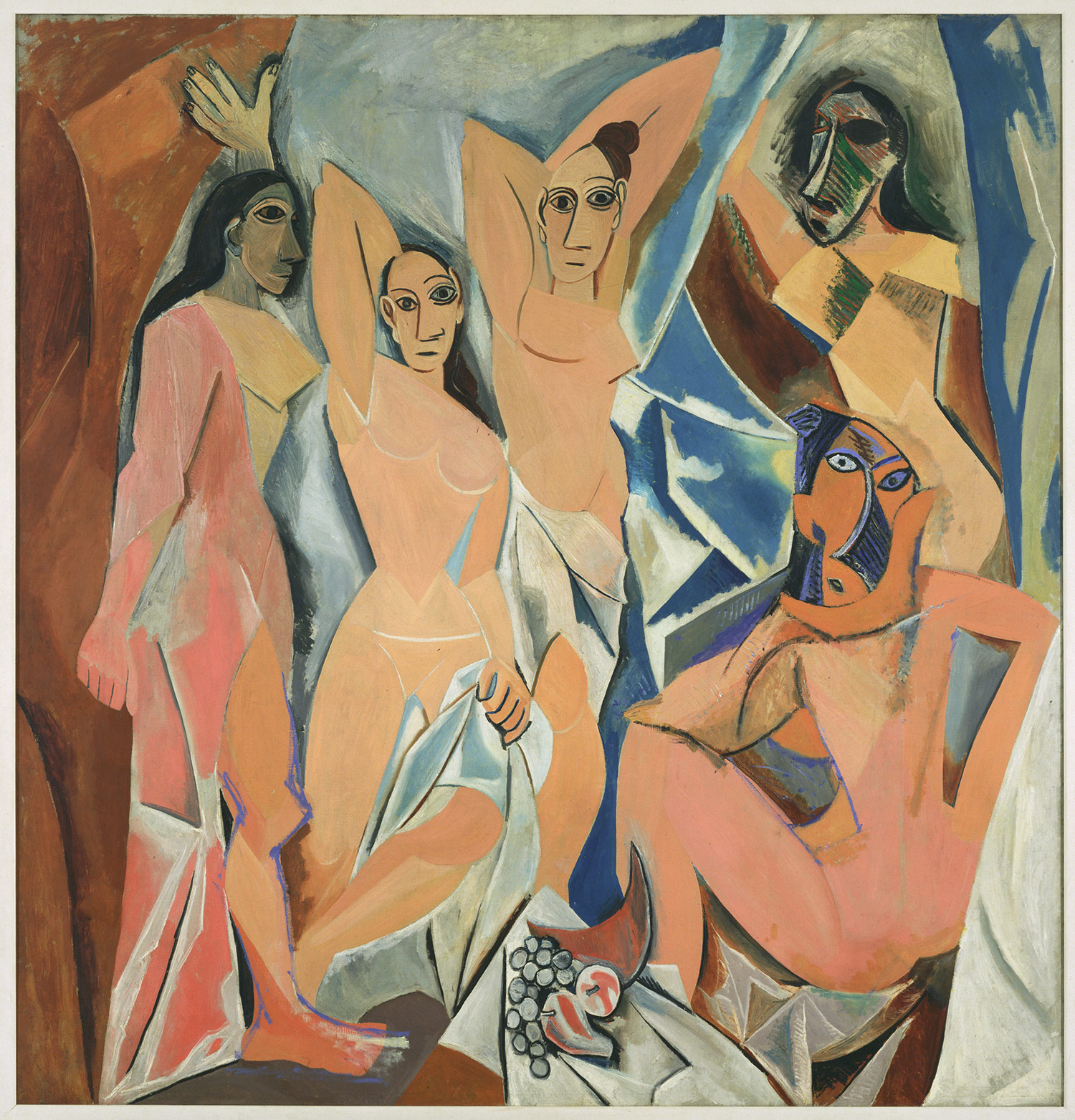
African sculptures had very strong influence on European art during 19th and 20th century. They inspired many artists because of their abstract form of the human body. French and Spanish painters Henri Matisse and Pablo Picasso as well as other artists from School of Paris (perhaps also influenced by Paul Gauguin and Paul Cezanne) adopted African sculptures style mixed with Cubist style in their paintings.

Although Picasso's paintings from his 'African Period' have really vivid colour palette and the faces became flat, he kept the Cubist style by fragmented shapes in his paintings. What I find interesting in his paintings from that period are the colours he had chosen and relationships between them. However, I do not like the flattened faces and shapes Picasso created as I am not fond of abstract art.


The Young Sailor, 1906 (above) by Henri Matisse is one of his paintings influenced by African art. I find this painting quite nice because of the texture of the clothes that the artist created - in some way it looks abstract and loose, but at the same time it is quite realistic. And again, I like the nice colours that Matisse used and I think they really look fantastic together.

I think that the African influence played a big role in the modern art. It also inspired later generations of artists - Jean Michel was one of them. He incorporated African art with graffiti art. In my opinion it is interesting approach and I think he did similar thing to what Cubists did, mixing two different styles of art to create something new.


Post-Impressionism

Post-Impressionism was a continuation and extended-version of the French movement - Impressionism. Post-Impressionist artist hadn't just stopped on vibrant colours and bold brush strokes but had gone further into structures, geometric forms, expression and exploring emotions in paint. Many of the appreciated artists were involved in this movement, such as Paul Cezanne, Vincent Van Gogh, Paul Gauguin or Charles Angrand.

Probaly the most famous of the artists during this era was Vincent Van Gogh. Although he was never appreciated during his life, at present his paintings are worth millions. Van Gogh was born in Zundert, Holland, 1853. He died at early age (37) after he commited suicide caused by a mental illness.

One of Van Gogh's most famous paintings is The Starry Night. It shows part of the village of Saint-Remy which Van Gogh seen through his sanitarium window.

I like this picture as it seems to me that the artist was probably trying to express astronomical view of the sky at night. I can clearly see the stars, moon and perhaps the Milky Way.

During that time, Van Gogh was perhaps influenced by the discovery of the M51a galaxy in 1744 and the sketch made by Lord Rosse.

The Starry Night

Whirpool Galaxy (M51a) Sketch

Other well-known works from Vincent Van Gogh are the Sunflower Series. One of them, specifically fourth version , can be seen in London National Gallery.The artist did not concentrated really on perspective, light or details but focused on impression of the flowers, colours and rather their form.